
Off the Rails:
Why Garage Doors Jump Their Tracks — And How to Make Sure Yours Never
Does
Posted by WagMore Garage Doors | Serving Northeast Florida
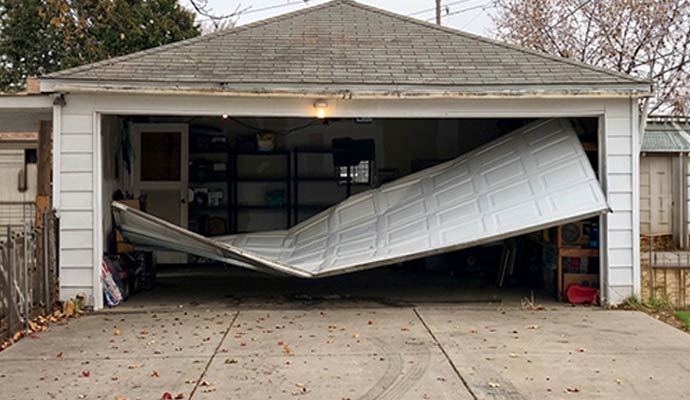
It starts with a grinding sound you've never heard before. Then the door tilts. One side lifts while the other lags behind. You hit the button again and it only gets worse — until the door is hanging sideways, rollers dangling in midair, and nothing is going anywhere.
A garage door off its tracks is one of the most alarming mechanical failures a homeowner can face. The door weighs between 150 and 300 pounds. It's under spring tension. And once it's derailed, you're dealing with a situation that requires care and — in most cases — a professional.
But here's the good news: most off-track incidents are preventable. Understanding why doors derail is the first step to making sure yours never does.
A garage door off its tracks isn't just an inconvenience — it's a
200-pound system under tension sitting outside its design tolerances.
Treat it accordingly.
THE FIVE CAUSES
Why Garage Doors Jump Their Tracks
Garage doors derail for a handful of reasons, and most of them involve a predictable chain reaction: one component fails or gets knocked out of alignment, and the others pay the price.
1. Impact Damage
This is the most common cause — and usually the most obvious. A car bumps the door while it's moving or partially open. A ladder tips into a panel. A baseball finds its way from the driveway into the bottom section.
Even a relatively gentle impact can bend a panel or knock a roller stem out of its bracket. The door continues operating after the hit — sometimes for days or weeks — until the misalignment worsens enough to cause a full derailment.
What to watch for: Any dent, especially near the bottom or corner panels, should be inspected immediately. Run the door manually and watch for wobble, hesitation, or uneven travel before assuming it's fine.
2. A Broken or Worn Torsion Spring
Your torsion spring does the heavy lifting — literally. When it snaps, the door loses its counterbalance and becomes dead weight. If the opener tries to run the door without that counterbalance, the asymmetric load can pull the door off the track.
Springs don't always announce their failure with the classic loud bang. A spring that's lost tension gradually — common with builder-grade springs that have exceeded their cycle count — can cause slow, uneven lifting that wears on the track hardware until something gives.
Pro Tip: If your door feels noticeably heavier than usual when you pull the emergency release and lift it by hand, your spring is losing tension. Don't wait for the snap — call for an inspection.
3. Worn or Broken Rollers
Rollers are the small wheels that ride inside the vertical and curved sections of the track. Standard builder-grade steel rollers typically last 10,000 to 15,000 cycles. Nylon rollers on higher-end doors can reach 30,000 or more. But when a roller stem cracks, the wheel flattens, or a bearing seizes — the roller fails to guide the door properly, and derailment follows.
Worn rollers are especially common in Northeast Florida because humidity accelerates bearing corrosion and our doors work year-round without the natural reprieve that colder climates provide during winter months.
4. Track Misalignment
The vertical tracks on either side of your door need to be parallel, plumb, and correctly gapped to the door panels. Over time, the lag screws and mounting brackets that hold the tracks to the wall can loosen from thousands of vibration cycles. The track shifts — by fractions of an inch, often invisibly — until the rollers no longer seat properly.
The gap between the track and the roller should be approximately 1/4 inch. Too wide, and the roller walks out. Too narrow, and it binds, putting stress on both the roller and the opener. Either extreme eventually leads to the door jumping the track.
5. Cable Problems
Lift cables run from the bottom bracket on each side of the door up and around a drum at the end of the torsion bar. When a cable frays, snaps, or slips off the drum — usually because of spring failure or a door that closed on an obstruction — the door loses even support on that side. The unbalanced load immediately puts the rollers at risk.
Safety Warning: Never attempt to rewind a cable that has come off the drum yourself. The cable is under torsion spring tension, and handling it improperly can cause serious injury. This is a job for a trained technician.
WHAT TO DO IF IT HAPPENS
Your Door Just Came Off the Track. Now What?
The most important thing you can do in the first 30 seconds is: stop operating the door.
Every additional button press — remote, wall button, or manual force — makes the situation worse. Rollers that are partially off the track can be guided back. Rollers that have been dragged against the track frame under motor power may be damaged beyond reuse.
- Disconnect the opener immediately. Pull the red emergency release cord to disengage the door from the drive system.
- Do not try to lift or force the door. A door off its tracks may be unstable, especially if a spring or cable has also failed.
- If the door is partially open and you need to close it for security, proceed slowly and only by hand — never with the opener — and only if you can verify the door won't drop.
- Call a technician. Most off-track repairs are straightforward for a trained tech — rollers reseated, hardware tightened, track realigned. But the diagnosis matters. Running the door again without identifying the root cause means it will come off the track again.
Minor off-track situations — where a single roller has popped out of a straight section of track — can sometimes be corrected by a careful homeowner using channel-lock pliers to gently open the track lip and guide the roller back in. But this should only be attempted if you're confident the spring and cables are intact, the door is stable, and you can identify clearly what caused the roller to come out in the first place.
PREVENTION
How to Keep Your Door on Track: A Prevention Checklist
The best off-track incident is the one that never happens. Here's what proactive homeowners in Northeast Florida should be doing — and watching for.
Inspect Your Rollers Annually
Most homeowners never look at their rollers until something goes wrong. Once a year — or whenever a technician visits — have the rollers inspected for cracked stems, flattened wheels, and bearing wear. Nylon rollers with ball bearings are the upgrade worth making at your next service visit: quieter, longer-lasting, and gentler on the track.
Tighten the Track Hardware
The lag screws and mounting brackets holding your tracks to the wall loosen over time. During a maintenance visit, every bolt and bracket should be checked and tightened with the right tools. This is a five-minute step that gets skipped constantly on bargain-price tune-up visits — and is one of the easiest ways to prevent a derailment.
Keep the Tracks Clean
Tracks should be clean and dry — not lubricated. Built-up grime, old grease, and debris in the track creates resistance that causes rollers to skip. Wipe the tracks down with a damp rag periodically, especially the bottom curved sections where dirt tends to collect.
Important: Tracks should be clean, not lubricated. Grease in the track collects debris and creates a grinding paste. The rollers and roller bearings get lubricated — not the track itself.
Watch for the Warning Signs
Your door will usually tell you something is wrong before it derails. Pay attention to:
- Grinding or scraping sounds during operation
- Visible wobble or shaking as the door travels
- One side of the door moving slower than the other
- The door requiring extra force from the opener to start moving
- Any visible gap between a roller and the track during travel
Don't Skip Impact Inspection
If a car, ladder, bike, or anything else contacts the door — even lightly — inspect it before operating it again. Run the door manually and watch carefully at the section that took the impact. A dent that looks minor from outside may have bent the roller bracket behind it.
Replace Builder-Grade Springs Before They Snap
Most new construction in Northeast Florida installs standard-cycle torsion springs rated for 10,000 cycles. A family using the garage four times a day reaches that limit in about seven years. High-cycle springs — rated for 25,000+ cycles — are one of the highest-value upgrades you can make at spring replacement time, and they dramatically reduce the risk of a surprise failure that leads to a derailment.
Most garage door derailments have a preventable root cause — a worn roller, loose hardware, or an ignored warning sign. A proper annual inspection catches all of them before they become an emergency.
NORTHEAST FLORIDA CONSIDERATIONS
The Florida Factor: Why This Matters More Here
Northeast Florida's climate creates specific conditions that accelerate the wear patterns behind most off-track incidents:
- Year-round operation means no off-season recovery for springs and rollers. A garage door in Jacksonville runs 365 days a year.
- Humidity corrodes roller bearings, accelerates rust on steel rollers and track hardware, and dries out or degrades plastic components faster than in drier climates.
- Salt air in coastal communities — Ponte Vedra Beach, Vilano, and South Ponte Vedra — attacks hardware aggressively. Stainless or powder-coated components and stainless cables are worth specifying in these areas.
- Hurricane season adds a category of risk most inland homeowners don't face. Wind-load rated doors are engineered to handle lateral pressure that non-rated doors are not — and a door that buckles under wind loading is a prime candidate for coming off its tracks.
WagMore's Safe & Sound Inspection
If your door is making sounds it didn't used to make, moving unevenly, or you simply can't remember the last time anyone looked at your rollers and track hardware — that's exactly what our $0 Safe & Sound Inspection is for. We go through every component that contributes to a derailment and give you a straight report on what's worn, what's borderline, and what's fine.
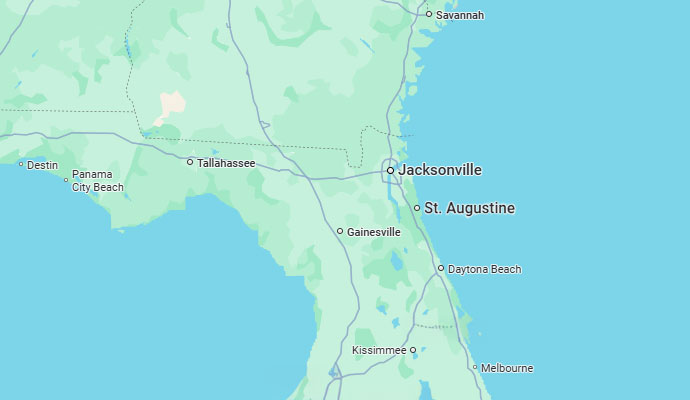
And if you've already had a derailment and need same-day service, we cover all of Duval and St. Johns County — from Fleming Island and World Golf Village to Ponte Vedra, Nocatee, Palencia, and St. Augustine.
Text us two photos for a same-day quote: one of the door from the driveway, one of the size sticker inside the top frame. We'll have a real number back to you the same day — no site visit required, no pressure.
904-584-4828







Garage Door Problems?
We turn "Uh-Oh" into
"ALL GOOD"
Is your garage door acting up? Don't worry, we've got you covered! Our expert technicians are here to diagnose and fix any garage door issues you may be experiencing. From broken springs to malfunctioning openers, the most likable techs you will ever meet will handle it all with precision and care.
Service Area
- Atlantic Beach
- Bartram Park
- Doctors Inlet
- Eagle Harbor
- Elkton
- Fleming Island
- Fleming Island Plantation
- Fruit Cove
- Green Cove Springs
- Hastings
- Jacksonville
- Jacksonville Beach
- Julington Creek Plantation
- Keystone Heights
- Lake Geneva
- Middleburg
- Neptune Beach
- Nocatee
- Oakleaf Plantation
- Orange Park
- Palm Coast
- Penney Farms
- Ponte Vedra
- Ponte Vedra Beach
- River Town
- Saint Augustine
- Saint Johns
- Sawgrass
- World Golf Village
