

Why Won't My Garage Door Open or Close?
WagMore Garage Doors | Northeast Florida | Repair & Troubleshooting
It's one of the most stressful things that happens at home: you press the button, and nothing happens. Or the door starts to move and reverses. Or it goes halfway up and stops. Or the remote works but the keypad doesn't. Or everything is silent and dark.
The good news: most of the reasons a garage door won't open or close are diagnosable in under five minutes — and many are fixable without a service call. This guide covers every common cause, in order of likelihood, so you can find your answer fast.
If it turns out you need a technician, we'll tell you that too — and explain exactly why.
904-584-4828
Start Here: The 60-Second Checklist
Before diving into causes, run through these fast checks. They catch the majority of calls we get:
- Is the opener plugged in and does the outlet have power? (Try plugging in a lamp.)
- Did a circuit breaker trip? Check the panel for any tripped breaker.
- Is the remote's battery dead? Try the wall button instead.
- Is the door in "lock" or "vacation" mode? Check the wall console for a lock switch.
- Has the emergency release cord been pulled? Look for the red cord hanging from the rail — if it was pulled, the door is disconnected from the motor.
- Are the safety sensor lights solid (not blinking)? Blinking or misaligned sensors prevent the door from closing.
If none of those solve it, keep reading. The sections below break down every cause in detail.
1. Dead Remote or Keypad Battery
This is the single most common reason a garage door appears to stop working — and it's the easiest fix. Most remotes use a CR2032 coin battery or a 9-volt. Most exterior keypads use a 9-volt.
How to confirm: If your wall button (mounted inside the garage) works fine but the remote or keypad doesn't, the battery is almost certainly the culprit. Try the wall button first.
- Swap in a name-brand battery — cheap batteries can fail faster than you'd expect.
- While the battery housing is open, wipe the contact points with a dry cloth or a bit of rubbing alcohol. Corroded contacts are common in Florida's humidity and cause intermittent failures even with a new battery.
- If you replace the battery and the keypad still doesn't respond, re-read the section on radio interference below — certain light bulbs can jam keypad signals.
2. Tripped Breaker or Power Issue
Your garage door opener runs on a standard 120V outlet. If the outlet loses power — from a tripped breaker, a tripped GFCI outlet, or a loose plug — the opener goes completely silent.
- Check your electrical panel for any tripped breaker (it'll sit in a middle position between ON and OFF). Reset it by flipping it fully OFF first, then ON.
- GFCI outlets (the ones with the test/reset buttons, often found near water sources) can trip and cut power to other outlets on the same circuit. Look for a tripped GFCI in your garage or nearby.
- Plug a lamp or phone charger into the same outlet your opener uses. If it doesn't work, the problem is the outlet or the circuit — not the opener.
Florida Outage Note
Summer storms in Northeast Florida knock out power regularly. If your opener doesn't have a battery backup, a power outage means no door — period. Manually disengage the door using the red emergency release cord (pull it straight down), then lift the door by hand. Re-engage by pulling the cord toward the opener unit at an angle and running the door once power is restored.
If this is a recurring frustration, modern LiftMaster and Chamberlain openers with built-in battery backup handle power outages automatically — the door works normally even with no power to the house.
3. Broken Torsion or Extension Spring
This is the most common mechanical reason a garage door won't open — and one of the most dramatic. When a torsion spring breaks, you'll typically hear a loud bang from the garage, like a firecracker or a gunshot. After that, the door becomes extremely heavy and won't open properly even if the motor is running.
Springs do the real lifting. Your opener just guides the movement — the springs counterbalance the door's weight (usually 150–300 lbs). Without working springs, the opener is trying to lift dead weight it was never designed to handle alone.
How to identify a broken spring: Look at the horizontal bar above the door. A torsion spring (the coiled spring on that bar) will show a visible 2-inch gap where it snapped. The door may start to go up crookedly, hang unevenly, or refuse to move at all.
Do Not Attempt DIY Spring Repair
Garage door springs are under extreme tension — enough to cause serious injury or death if released incorrectly. This is not a job for a YouTube tutorial and a weekend afternoon. If you've confirmed a broken spring, call a professional. Do not attempt to lift the door manually if a spring is broken (the door can weigh hundreds of pounds without the spring's counterbalance).
At WagMore, spring replacement is one of our most common service calls. We install high-cycle springs rated for 25,000+ cycles — compared to the 10,000-cycle standard springs found in most homes — and we back them with a Forever Warranty. If your spring fails again while you own the home, we replace it for free.
4. Misaligned or Blocked Safety Sensors
Since 1993, all residential garage door openers have been required to include safety reversal sensors. These are the small photo-eye units mounted near the bottom of each track, facing each other. They project an invisible beam across the opening. If anything breaks that beam — or if the sensors fall out of alignment — the door won't close. It'll start to move and immediately reverse, or it won't move at all.
This is the most common reason a garage door won't close but will open fine.
- Look at both sensor units. Each one has a small LED. One should be solid green (the sending unit), one should be solid amber (the receiving unit). If either light is blinking or off, the sensors are out of alignment or blocked.
- Wipe the lens of each sensor with a dry cloth — dirt, cobwebs, and moisture can interrupt the beam.
- Gently adjust the receiving sensor (the amber one) until both lights go solid. They need to be pointed directly at each other.
- Check for objects in the path of the beam — even a broom handle or a garden hose lying on the floor can trigger the safety reverse.
If the sensors look aligned and clean but the door still won't close, check whether the sensor wires have been damaged or pulled loose from the opener unit. Wires running along the track can get pinched, frayed, or detached over time.
5. The Door Is in Lock Mode or Vacation Mode
Most wall-mounted garage door consoles have a lock or vacation mode that disables all remote signals. This is designed for security when you're traveling — so the door can't be opened by any remote or keypad, only by the wall button inside the garage.
If this mode is accidentally activated (and it happens more often than you'd think, especially if kids or guests were near the console), your remote will appear completely dead while the wall button works perfectly.
- Look at your wall console for a slide switch, toggle, or button labeled "Lock," "Vacation," or with a lock icon. Slide or press it back to the unlocked position.
- On some LiftMaster and Chamberlain models, holding the light button for a few seconds toggles lock mode — a light or indicator on the console will confirm the status.
6. Limit Settings Are Off on the Opener
Your opener has internal limit settings that tell it how far to travel in each direction — fully open and fully closed. If these settings drift (which can happen after a power surge, when the opener is jostled, or simply over time), the door may stop short of fully open, reverse before it's fully closed, or exhibit erratic behavior.
Symptoms of incorrect limit settings:
- Door opens partway, then stops or reverses.
- Door closes but immediately reopens before resting on the ground.
- Door closes fully but the motor keeps running for a second after it's down.
Limit adjustment is done with a screwdriver on adjustment screws or dials on the opener unit — labeled UP, DOWN, or LIMIT. Your opener's manual will show the exact process; most can be found on the manufacturer's website by model number. If you're not comfortable adjusting these, this is a quick and inexpensive service call.
7. Frayed or Snapped Lift Cables
Lift cables run from the bottom bracket of the door, up through a pulley system, and connect to the springs. They're what transfers the spring's counterbalance force to the door. If a cable frays or snaps, the door loses its ability to travel safely and evenly — it may hang at an angle, drop on one side, or go off the tracks entirely.
Visually inspect the cables along both sides of the door. A frayed cable looks like a bundle of steel wire where individual strands are broken and sticking out. A snapped cable will be visibly separated, often hanging loose or tangled.
Cables Are a Professional Repair
Like springs, cables are under significant tension during operation. A cable under load can snap with force. If you see frayed or broken cables, do not try to operate the door or repair the cables yourself. Call a professional.
8. The Door Has Come Off Its Tracks
If your door is visibly crooked, hanging at an angle, or making a scraping or grinding sound, it may have jumped the tracks. This happens after an impact (backing into the door, a debris strike), from severely worn rollers, or from a track that has bent or shifted out of alignment.
A door off the tracks is a safety hazard. It can fall, it puts enormous stress on the opener motor, and operating it further risks damaging cables, rollers, and the door panels themselves.
- Do not try to force the door open or closed if it's visibly crooked or scraping.
- Disengage the opener using the red emergency release cord so the motor can't try to run the door.
- Call a technician. Track realignment and roller replacement are straightforward repairs for a professional and relatively inexpensive — much less costly than a panel or cable replacement after a forced operation.
9. Radio Frequency Interference
This one surprises most homeowners: the wrong light bulb inside your opener can jam your remote. Modern garage door openers communicate on radio frequencies between 315 and 915 MHz. Standard LED bulbs — especially cheap or unbranded ones — emit electromagnetic interference (EMI) from their internal driver circuits that can degrade or block those signals entirely.
Symptoms of interference: your remote only works within a few feet of the opener (instead of from the end of the driveway), or it works reliably when the opener light is off but fails when it's on.
- Replace the bulb inside your opener with an opener-rated LED (LiftMaster, Chamberlain, and Genie all make them) or a standard 60W incandescent. Test with the light on and off.
- LED shop lights and strip lighting mounted near the opener can also cause interference. Try temporarily unplugging them to isolate the source.
- Check that the antenna wire hanging from your opener is straight and hanging down — not coiled, kinked, or tucked against the unit.
10. The Opener Remote Needs Reprogramming
Remotes and keypads can lose their pairing with the opener — most commonly after a power outage, if someone accidentally pressed the "Learn" button on the motor unit, or when the opener's memory was reset. When this happens, the remote or keypad simply doesn't "speak" to the opener anymore.
To re-pair a remote: press the Learn button on the opener unit (it's usually on the back or side, sometimes under a light cover). The indicator light will come on. Within 30 seconds, press the button on your remote you want to program. The opener light will flash or click to confirm pairing.
Keypads follow a similar process — typically: enter your PIN on the keypad, press the Learn button on the opener, then press Enter or the keypad button again. Consult your opener's manual for the exact sequence, or search your model number online.
11. The Opener Motor Is Failing
If the opener hums or buzzes when you press the button but the door doesn't move — and everything else checks out — the motor may be failing. This can happen when:
- The opener is straining against a door that's too heavy for its horsepower rating (common when a new, heavier insulated door is paired with an old opener).
- The motor capacitor has failed (the capacitor is what starts the motor — when it goes, the motor hums but doesn't turn).
- The circuit board has been damaged by a power surge or age.
Openers more than 10–15 years old are candidates for replacement rather than repair. Today's openers include battery backup, rolling code security, smartphone integration, and soft-start motors — and they're engineered to handle the weight of modern insulated doors. The upgrade cost is often justified by the reliability and features you gain.
Quick Reference: Symptom → Most Likely Cause
| Symptom | Most Likely Cause | DIY or Pro? |
|---|---|---|
| Loud bang, door won't open | Broken torsion spring | Pro only |
| Motor runs, door doesn't move | Disconnected trolley, broken spring, or motor failure | Check trolley first; Pro for rest |
| Door won't close, reverses immediately | Safety sensors misaligned or blocked | DIY — clean and align sensors |
| Remote doesn't work, wall button does | Dead battery, lock mode, or RF interference | DIY — check battery and lock switch |
| Door opens but won't close at all | Safety sensor issue or limit setting | DIY first; Pro if adjustments needed |
| Door stops partway, reverses | Limit settings off, obstruction, or worn rollers | DIY check, Pro if hardware |
| Door is crooked or scraping | Off track or broken cable | Pro only |
| Complete silence, no lights | No power — breaker or GFCI tripped | DIY — check panel and outlets |
| Keypad stopped working | Dead battery, lockout mode, or lost pairing | DIY — battery, then re-program |
| Remote range suddenly shorter | RF interference (wrong bulb) | DIY — swap to opener-rated bulb |
When to Call a Professional — and What to Expect
Some garage door problems are genuinely DIY-friendly — dead batteries, locked-out remotes, dirty sensors. Others are not, and attempting them risks injury or significantly more damage to the door system.
Call a professional for:
- Any broken spring — torsion or extension.
- Frayed, tangled, or snapped lift cables.
- A door that has come off the tracks.
- Opener motor failure or circuit board issues.
- Any repair where you're unsure of the safe working state of the spring system.
A legitimate service visit for a break/fix repair should include a full balance test (door disconnected from the opener and held at mid-point to assess spring tension), spring and cable inspection, hardware check, and an honest assessment of what needs repair now vs. what can wait. If a technician skips the diagnostic and goes straight to writing a quote, that's a warning sign.
At WagMore, our Safe & Sound 16-Point Inspection is included with every service visit. We look at the whole system — not just the component that failed — and give you a straight answer about what's needed and what isn't.
A Note on Northeast Florida Conditions
Garage door hardware in our part of Florida works harder than it does almost anywhere else in the country. The combination of heat, humidity, salt air (especially in Ponte Vedra Beach, Vilano Beach, and coastal communities), and daily temperature cycling accelerates wear on springs, cables, rollers, and opener components.
- Springs rust faster in humid, salt-air environments — this increases friction in the coils and shortens their life. High-cycle springs made from thicker, higher-grade steel are significantly more resistant to this.
- Rubber seals and weatherstripping degrade faster in Florida UV and heat — a deteriorated bottom seal lets in moisture, pests, and humid air that accelerates corrosion of hardware inside the garage.
- Opener circuit boards and remotes are more susceptible to condensation issues when temperature swings are sharp — a common occurrence when a cool garage door opener is exposed to hot, humid air after a summer afternoon storm.
If your door is more than 10–12 years old and you're starting to see recurring issues, the cumulative effect of Florida climate is often the underlying story — and a repair conversation becomes a replacement conversation. We'll tell you honestly which it is.
Your Door Won't Wait — Neither Will We.
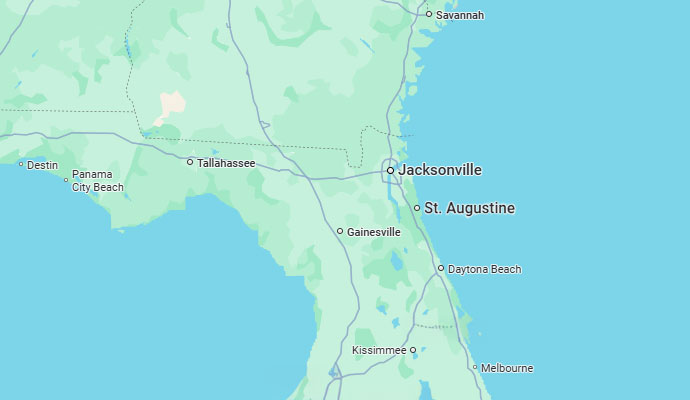
WagMore Garage Doors serves Duval and St. Johns County with same-day repair on most broken springs, cables, openers, and stuck doors. Our technicians carry the parts most commonly needed — so the first visit is usually the last.
Serving Nocatee · World Golf Village · Ponte Vedra · St. Augustine ·
Fleming Island · Jacksonville








Garage Door Problems?
We turn "Uh-Oh" into
"ALL GOOD"
Is your garage door acting up? Don't worry, we've got you covered! Our expert technicians are here to diagnose and fix any garage door issues you may be experiencing. From broken springs to malfunctioning openers, the most likable techs you will ever meet will handle it all with precision and care.
Service Area
- Atlantic Beach
- Bartram Park
- Doctors Inlet
- Eagle Harbor
- Elkton
- Fleming Island
- Fleming Island Plantation
- Fruit Cove
- Green Cove Springs
- Hastings
- Jacksonville
- Jacksonville Beach
- Julington Creek Plantation
- Keystone Heights
- Lake Geneva
- Middleburg
- Neptune Beach
- Nocatee
- Oakleaf Plantation
- Orange Park
- Palm Coast
- Penney Farms
- Ponte Vedra
- Ponte Vedra Beach
- River Town
- Saint Augustine
- Saint Johns
- Sawgrass
- test-Fleming Island
- test-Palm Coast
- test-World Golf Village
- World Golf Village
