
YOUR GARAGE DOOR WILL BREAK.
YOU JUST DON'T KNOW WHEN.
WE CAN TELL YOU HOW CLOSE.
Why Northeast Florida homeowners schedule a Safe & Sound Check-Up before something goes wrong — not after.
You don't know there's a problem. That's the problem.
Your garage door opened this morning. It'll open tonight. So you assume it's fine.
But here's what's actually happening while you assume: your springs are cycling through their rated lifespan, one open-close at a time. Your rollers are wearing at the stem. Your cables are under tension, every single day, in Florida humidity. Your bottom seal is compressing, cracking, letting in the heat and the bugs and the rain.
None of that announces itself. Until it does — at 6 a.m., when you're already running late, and the door goes nowhere.
The worst garage door failures are the predictable ones nobody predicted.
904-584-4828⚡ QUICK ANSWER
An annual garage door inspection (called a Safe & Sound Check-Up) is a 18-point calibration, lubrication, and written assessment of your door's current condition. A trained technician can identify how many cycles your springs have left, what components are showing wear, and what needs attention now versus later — before a $0 problem becomes a $950 emergency. WagMore Garage Doors offers this in Duval and St. Johns County for $0.
What Is a Garage Door Safe & Sound Check-Up?
A Safe & Sound Check-Up is a 18-point inspection, calibration, and lubrication service performed by a trained technician. It's not a sales call. It's not a tune-up you schedule because something's wrong. It's a scheduled annual check of your door's actual condition — with a written report you keep.
Think of it the way you think of a physical with your doctor. You're not sick. But you want to know what's coming before it costs you more to fix.
At WagMore, the Safe & Sound Check-Up includes:
- Spring tension test and cycle-life estimate
- Cable inspection (fraying, kinking, bottom bracket attachment)
- Roller condition check — spin, wobble, stem wear
- Track alignment (vertical plumb, horizontal level, gap clearance)
- Hardware tightening — hinges, brackets, track bolts
- Balance test — door disconnected from opener, held at midpoint
- Opener force and auto-reverse sensitivity test (safety-critical)
- Weatherseal and bottom seal visual inspection
- Lubrication — right product, right component, not a general spray-down
- Written report with condition rating on every point
You get a document. Not a verbal "looks good." A written assessment of what's in shape, what's wearing, and what needs attention.
What "We Can Tell You How Close It Is" Actually Means
Springs don't fail randomly. They fail on a cycle count.
Standard springs are rated for approximately 8,000-10,000 cycles. If your household opens and closes the door four times a day, that's about 1,460 cycles a year — which means a standard spring lasts roughly 6 to 7 years. A trained technician can look at your spring, measure the wire gauge, assess the condition, and give you a realistic estimate of where you are in that lifespan.
WALLY'S TAKE
We can't tell you it fails Tuesday. We can tell you if it's weakening, and that Florida humidity has accelerated surface rust, and that you're likely looking at a failure within the next 12 to 18 months. That's not a guess. That's a mechanic reading your engine. The choice you have after that conversation is different than the choice you have at 6 a.m. with a stuck door and nowhere to be.
Why Florida Makes This More Urgent
Northeast Florida is harder on garage door systems than most of the country.
Salt air accelerates surface rust on springs — especially in Ponte Vedra Beach, Vilano, and coastal St. Augustine. Rust on a spring coil isn't cosmetic; it creates friction that shortens cycle life and increases snap risk.
Florida humidity attacks the bottom seal, causes rollers to swell and bind, and corrodes hardware faster than inland climates. Cable corrosion is particularly common here and almost never visible until the cable fails.
Heat cycling — the door bakes to 130°F on a west-facing exposure in July, cools overnight — puts mechanical stress on every fastener and bracket across thousands of cycles.
A door installed in Nocatee, World Golf Village, or Fleming Island five years ago has been through more than a door in a moderate climate twice its age.
IMPORTANT
Annual checks in Northeast Florida aren't optional maintenance. They're
the cost of operating a mechanical system in an aggressive environment.
The Balance Test: The One Check That Tells You Everything
If you do nothing else, do this: disconnect your opener using the red emergency release cord and hold your door at the midpoint — roughly waist height — then let go.
A properly balanced door stays put.
If it drifts up, the spring tension is too high. If it drops, the spring is failing or tension is too low. Either way, your opener is compensating for an imbalance it wasn't designed to carry — burning through its motor and shortening the life of your entire system.
Most homeowners who fail this test have no idea their door is out of balance. Their door has been opening and closing every day, so they assume it's fine.
The balance test takes 30 seconds. It tells you more about your door's health than anything else you can check yourself.
What Happens at the End of an Inspection
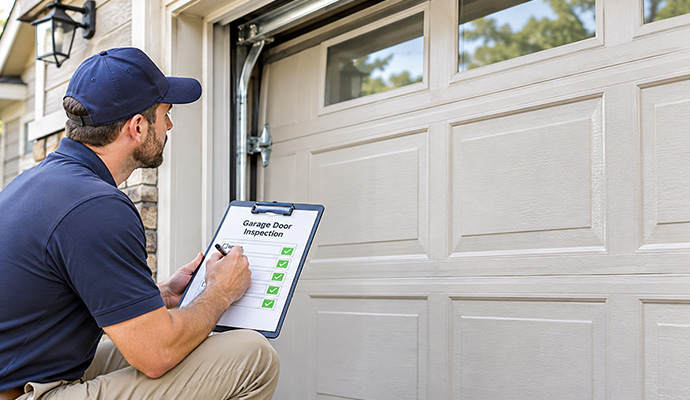
You get a written report. Every point rated. Every finding noted.
- Green — in good shape, no action needed
- Yellow — wear detected, monitor or address in the next 6 to 12 months
- Red — repair recommended now, before it becomes an emergency
How Often Should You Schedule This?
Once a year is the baseline.
If your door gets heavy use — more than four cycles a day, multiple drivers in the household — every six months is smarter.
If your door is more than 10 years old, annually is the floor. More frequent checks let you track the rate of wear, not just the current state.
If you've never had it inspected, schedule one now regardless of how the door feels. "Feels fine" is not a maintenance strategy.
904-584-4828FREQUENTLY ASKED QUESTIONS
How much does a garage door inspection cost in Jacksonville or St. Johns County?
How do I know if my garage door springs are close to failing?
What does a garage door tune-up include?
Can my garage door look fine but still have a serious problem?
How long does a garage door inspection take?
What is a garage door balance test?
What garage door brands do you service in Northeast Florida?
SCHEDULE YOUR SAFE & SOUND CHECK-UP
$0 · 16-Point Inspection · Written Report · No Commission · No Pressure
Serving Jacksonville, Nocatee, Ponte Vedra, St. Augustine, World Golf Village, Fleming Island, St. Johns, and all of Duval and St. Johns County.
Wag more. Worry less.








Garage Door Problems?
We turn "Uh-Oh" into
"ALL GOOD"
Is your garage door acting up? Don't worry, we've got you covered! Our expert technicians are here to diagnose and fix any garage door issues you may be experiencing. From broken springs to malfunctioning openers, the most likable techs you will ever meet will handle it all with precision and care.
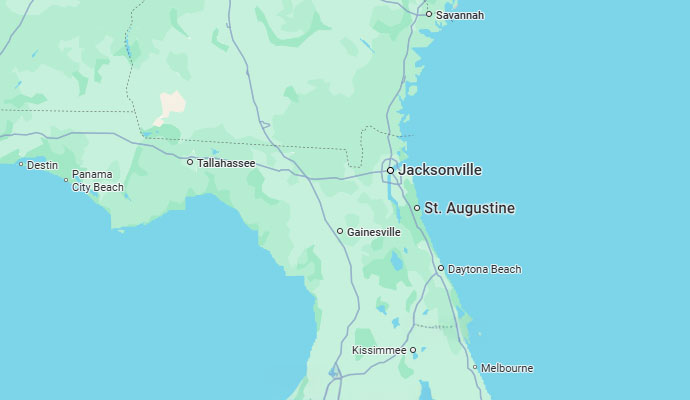
Wagmore Garage Doors Service Area
- Atlantic Beach
- Bartram Park
- Doctors Inlet
- Eagle Harbor
- Elkton
- Fleming Island
- Fleming Island Plantation
- Fruit Cove
- Green Cove Springs
- Hastings
- Jacksonville
- Jacksonville Beach
- Julington Creek Plantation
- Keystone Heights
- Lake Geneva
- Middleburg
- Neptune Beach
- Nocatee
- Oakleaf Plantation
- Orange Park
- Palm Coast
- Penney Farms
- Ponte Vedra
- Ponte Vedra Beach
- River Town
- Saint Augustine
- Saint Johns
- Sawgrass
- World Golf Village
