
WAGMORE GARAGE DOORS · NORTHEAST FLORIDA · QUIET OPENERS & HOME
COMFORT
Don’t Wake the Baby: How to Convert a Noisy Chain Drive Opener to a Whisper-Quiet Belt or Jackshaft
The garage door is often the loudest thing that happens in your house before sunrise — and the last thing at night. If your opener rattles a nursery, a bedroom, or a bonus room every time it cycles, here’s how to silence it for good.
904-584-4828Quick Answer
The most effective way to stop a garage door opener from waking the house is to replace a chain drive opener with a belt drive or wall-mount (jackshaft) opener. Chain drives are the loudest common opener type because a metal chain vibrates the ceiling and carries noise straight into the rooms above and beside the garage. Belt drives run significantly quieter by swapping the chain for a reinforced rubber belt, and jackshaft openers mount on the wall — off the ceiling entirely — for the quietest operation available. Pair either with soft-start/soft-stop motors and nylon rollers and most families stop hearing the door at all.
Why Your Chain Drive Opener Is So Loud (It’s Not Just the Motor)
Most people blame the motor for the racket. The motor is rarely the real culprit. On a chain drive opener, a metal chain — much like a bicycle chain — drags the door along the rail, and that chain rattles, slaps, and vibrates the entire steel rail it rides on.
Here’s the part that matters for your sleep: that vibration doesn’t stay in the garage. The opener is bolted to the ceiling joists, and those same joists frame the bedroom or bonus room on the other side of the drywall. The noise travels through the structure of the house — engineers call it structure-borne noise — which is why the door often sounds louder in the room above the garage than it does standing in the garage itself.
In Northeast Florida, where nearly every home has an attached garage — and plenty of newer builds in Nocatee, World Golf Village, and Ponte Vedra put a bedroom, office, or bonus room directly over it — that structure-borne path is exactly the problem. The door cycles at 5:30 a.m. and the whole upstairs hears it.
The Real Problem Isn’t Decibels — It’s Timing
A garage door isn’t loud all day. It’s loud at exactly the wrong moments. And in most households, the door’s schedule and the family’s sleep schedule are on a collision course:
- The 5:30 a.m. commute —one spouse leaves for work while the newborn (and everyone else) is still asleep.
- The nap window — you finally got the baby down, and someone pulls into the driveway.
- The night-shift schedule — a partner sleeping during the day, woken every time the door cycles.
- The late arrival — a teenager home after curfew, announcing it to the whole house.
You can’t reschedule work, and you can’t reschedule a baby. The one thing you can change is how much noise the door makes when it moves. That’s the entire case for a quiet-opener conversion: not a quieter house at noon, but a quieter house at 5:30 a.m. and 10:00 p.m., every single day.
Wally’s Take
A quiet opener is one of the few upgrades you feel every day and hear never. Families tell us the conversion paid for itself the first morning nobody woke up. We match the opener to your door’s weight and your garage’s layout — no guesswork, and no commissioned salesperson deciding what you “need.”
The Better Fix: Belt Drive Openers
A belt drive opener replaces that noisy metal chain with a steel-reinforced rubber, polyurethane, or fiberglass belt. The belt does the same job — pulling the door along the rail — but without metal-on-metal rattle. The result is a dramatically quieter, smoother cycle.
Belt drives are the sweet spot for most attached-garage homes. They’re significantly quieter than a chain drive, they’re affordable, and modern units add features that compound the quiet:
- Soft-start / soft-stop motors ease the door into motion and slow it before it lands, instead of the jarring lurch-and-slam of older units.
- DC motors run quieter and smoother than the older AC motors in most aging chain drives.
- Battery backup keeps the door working through Florida storm outages — a meaningful bonus heading into hurricane season.
Best for: families with an attached garage and a bedroom, nursery, office, or bonus room anywhere near or above it.
The Quietest Fix: Wall-Mount (Jackshaft) Openers
If a belt drive is quiet, a jackshaft opener is silent by design. Instead of hanging from the ceiling on a rail, a jackshaft (wall-mount) opener bolts to the wall beside the door and turns the torsion bar directly. There is no ceiling rail, no chain, no belt running the length of the garage — and critically, nothing bolted to the joists that frame your bedroom floor. By removing the ceiling-mount path entirely, a jackshaft eliminates the structure-borne vibration that makes chain drives sound so loud in the rooms above. For a bonus room directly over the garage, this is the single most effective noise fix available.
Jackshafts carry a few extra advantages that Northeast Florida homeowners appreciate:
- They free up the entire ceiling — ideal for high, sloped, or storage-heavy garages common in newer WGV and Ponte Vedra builds.
- They’re the cleanest, most modern look, with no bulky unit hanging overhead.
- Battery backup and smart features come standard on most models.
Best for: bedrooms or bonus rooms directly above the garage, high or sloped ceilings, and homeowners who want the quietest possible operation.
Chain vs. Belt vs. Jackshaft: The Quiet Comparison
| Opener Type | Noise Level | How It Mounts | Best For |
|---|---|---|---|
| Chain Drive | Loudest | Ceiling rail, metal chain | Detached garages only |
| Belt Drive | Significantly quieter | Ceiling rail, reinforced belt | Attached garages, rooms nearby |
| Jackshaft (Wall-Mount) | Quietest | Wall-mounted, no ceiling rail | Bedrooms/bonus rooms above garage |
Weighing opener types more broadly — power, price, and features beyond noise? See our full Guide to Garage Door Openers for the complete Good-Better-Best breakdown.
“Can I Just Quiet My Existing Chain Drive Instead?”
Honest answer: partly. A few maintenance moves will take the edge off a rattly chain drive, and they’re worth doing regardless:
- Swap steel rollers for nylon rollers — one of the biggest single noise reductions you can make.
- Tighten every bolt — hinges, brackets, rail, and mounting hardware all loosen over thousands of cycles and buzz when they do.
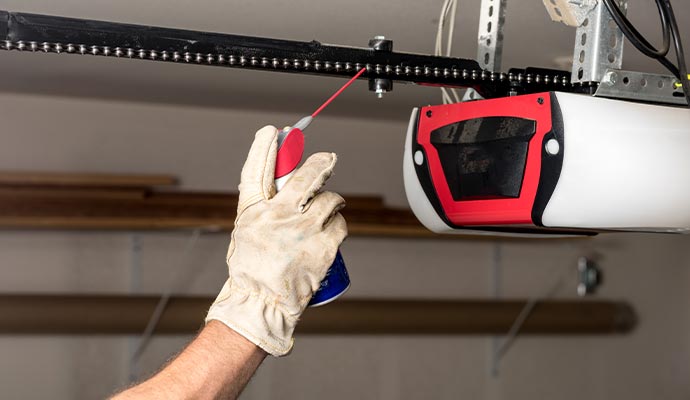
- Lubricate the right parts the right way — a dry chain and dry hinges are loud hinges. (See our guide to the right lube for the job.)
- Add rubber isolation between the opener bracket and the ceiling to interrupt the vibration path.
These help. What they can’t do is turn a chain drive into a belt drive — the chain itself is the noise source, and it’s still there. If your chain drive is more than 10 years old, it’s also missing battery backup, rolling-code security, and soft-start motors. At that point, the money is better spent converting than chasing rattles on a unit that’s near the end of its life anyway.
It’s Not Always the Opener: Other Things That Wake the House
Before you assume the opener is the villain, rule out the door itself. A brand-new silent opener can’t fully mask a noisy door. Common culprits:
- Worn or steel rollers grinding in the track.
- Loose hardware buzzing and slapping through the cycle.
- Dry or worn springs — a spring at the end of its cycle life gets loud before it fails. (More on that in our guide to garage door spring warning signs.)
- A bent or misaligned track causing the door to drag and thump.
The quietest possible setup is a jackshaft or belt drive paired with a tuned, well-balanced door on nylon rollers. That’s exactly what our Safe & Sound inspection checks for.
The $0 Safe & Sound Difference
Every WagMore visit includes a 16-point Safe & Sound inspection at no charge. We test balance, springs, rollers, and hardware — the parts that actually make a door loud — before we ever talk openers. Our technicians are salaried, not commissioned, so the recommendation you get is the one your door actually needs. And our high-cycle springs carry the Furever Warranty: if they fail while you own the home, we replace them free, parts and labor.
Why This Matters for Northeast Florida Homes
Attached garages are the norm here, and open floor plans carry sound. In master-planned communities like Nocatee, World Golf Village, Palencia, and Ponte Vedra, it’s common to find a nursery, primary suite, or bonus room sharing a wall or floor with the garage. That layout is exactly where a chain drive is most disruptive — and where a belt or jackshaft conversion delivers the most obvious payoff.
There’s a storm-season bonus, too. Converting to a modern belt or jackshaft opener means you also gain battery backup — so when a summer squall or tropical system knocks out power, your door still opens and closes on demand. Quieter mornings now, and a working door during the next outage.
One Thing to Leave to a Pro
A jackshaft opener connects directly to the torsion bar, and any opener swap involves a door under extreme spring tension. This isn’t a DIY weekend job — an unbalanced or improperly set opener can damage the door, void your warranty, or cause injury. Let a trained technician size, mount, and tune the system.
Frequently Asked Questions
What is the quietest garage door opener?
Is a belt drive opener really quieter than a chain drive?
Will a jackshaft opener still wake people sleeping upstairs?
Can I make my existing chain drive quieter without replacing it?
Why does my garage door sound louder in the bedroom than in the garage?
How much does it cost to convert to a quiet opener?
Does a quieter opener actually help with a baby’s sleep schedule?
READY FOR A QUIETER MORNING?
Text Us Two Photos for a Same-Day Quote
One photo of your door from the driveway, one of your current opener. We’ll tell you whether a belt or jackshaft conversion is the right call for your home — and send a real budget range the same day. No site visit, no pressure, no commissioned salesperson at your door.








Garage Door Problems?
We turn "Uh-Oh" into
"ALL GOOD"
Is your garage door acting up? Don't worry, we've got you covered! Our expert technicians are here to diagnose and fix any garage door issues you may be experiencing. From broken springs to malfunctioning openers, the most likable techs you will ever meet will handle it all with precision and care.
Wagmore Garage Doors Service Area

- Atlantic Beach
- Bartram Park
- Doctors Inlet
- Eagle Harbor
- Elkton
- Fleming Island
- Fleming Island Plantation
- Fruit Cove
- Green Cove Springs
- Hastings
- Jacksonville
- Jacksonville Beach
- Julington Creek Plantation
- Keystone Heights
- Lake Geneva
- Middleburg
- Neptune Beach
- Nocatee
- Oakleaf Plantation
- Orange Park
- Palm Coast
- Penney Farms
- Ponte Vedra
- Ponte Vedra Beach
- River Town
- Saint Augustine
- Saint Johns
- Sawgrass
- World Golf Village
